

Deep Server Monitoring for MT4/MT5 Brokers
Monitor your MT4/MT5 infrastructure in one dashboard. Detect trading slowdowns, rejected requests, and server issues with custom monitoring rules.


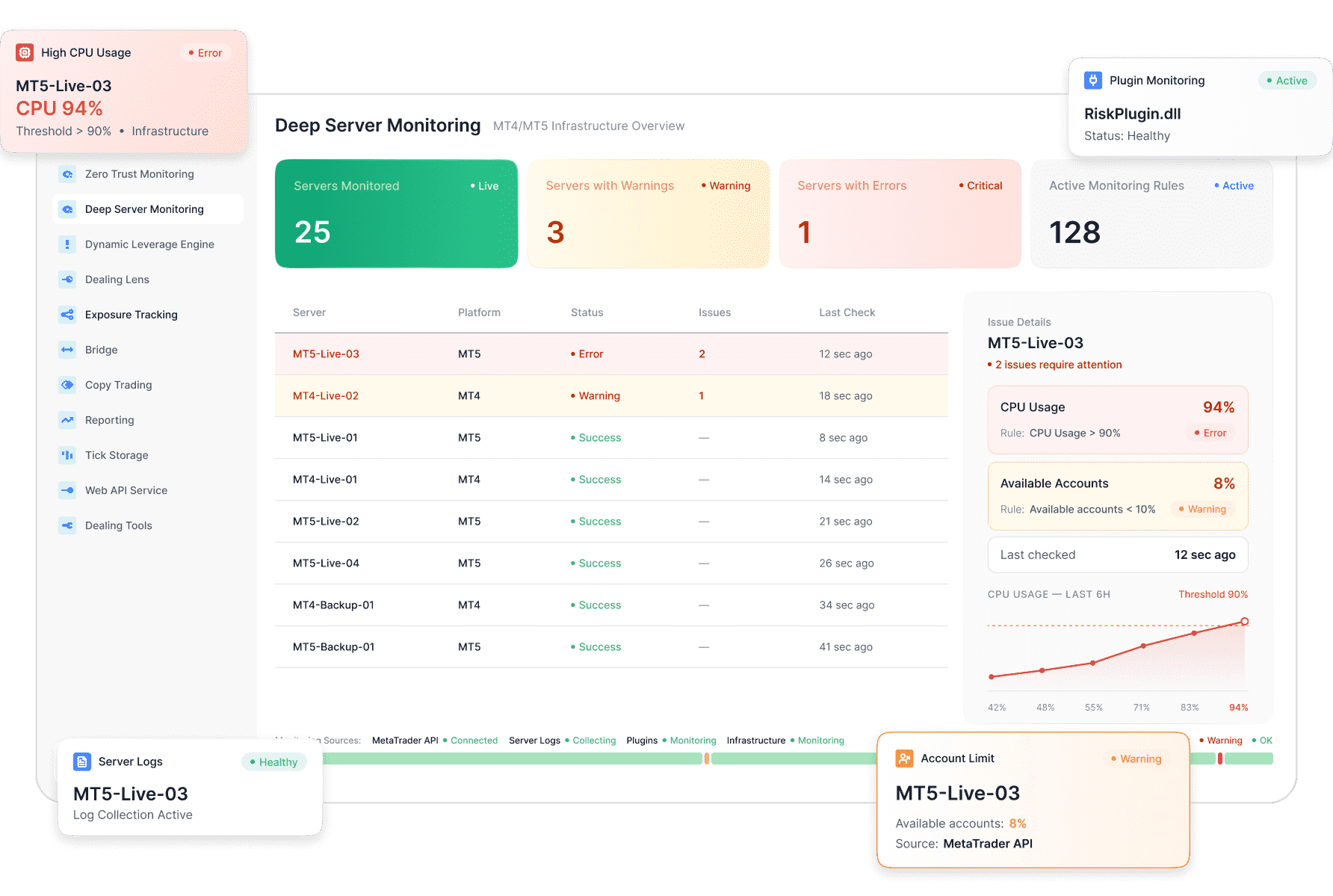


Deep monitoring across your MT4/MT5 infrastructure


Monitoring that finds problems for you
“Without proper monitoring, your team still has to keep checking – server by server, tab by tab.
Deep Server Monitoring does that routine work automatically and shows your team when something needs attention.
So instead of constantly looking for problems, your dealers can focus on solving them when they actually happen.”

Why brokers choose Devreon Deep Server Monitoring
The monitoring challenge, in our client’s words
“MetaTrader already has monitoring, but it becomes difficult to use when you have multiple servers.
When you’re switching between five or seven servers and checking different tabs, it’s easy to miss an important indicator. Having everything monitored together makes a real difference.”
MT4/MT5 server monitoring tracks the health and performance of a broker’s trading infrastructure.
It helps teams detect connection issues, quote problems, execution errors, resource limits, plugin issues, and infrastructure problems before they affect more clients.
Deep Server Monitoring brings data from multiple MT4/MT5 servers into one dashboard.
Brokers can see the status of their infrastructure without switching between individual servers and monitoring tabs.
Yes. Deep Server Monitoring can be used with a single MT4/MT5 server as well as larger multi-server environments.:
Its value becomes especially visible as infrastructure grows, because teams can monitor additional servers through the same dashboard and monitoring logic.
Standard MetaTrader monitoring works server by server.
As the number of MT4/MT5 servers grows, dealing teams have to check more servers and tabs manually, increasing the risk of missing important warnings or problems.
Deep Server Monitoring tracks connection status and available trading metrics, including MT5 trading activity, request processing times, execution performance, and trade rejections.
It also supports custom monitoring rules to identify unusual conditions across your trading infrastructure.
Deep Server Monitoring checks monitored parameters against predefined rules and thresholds.
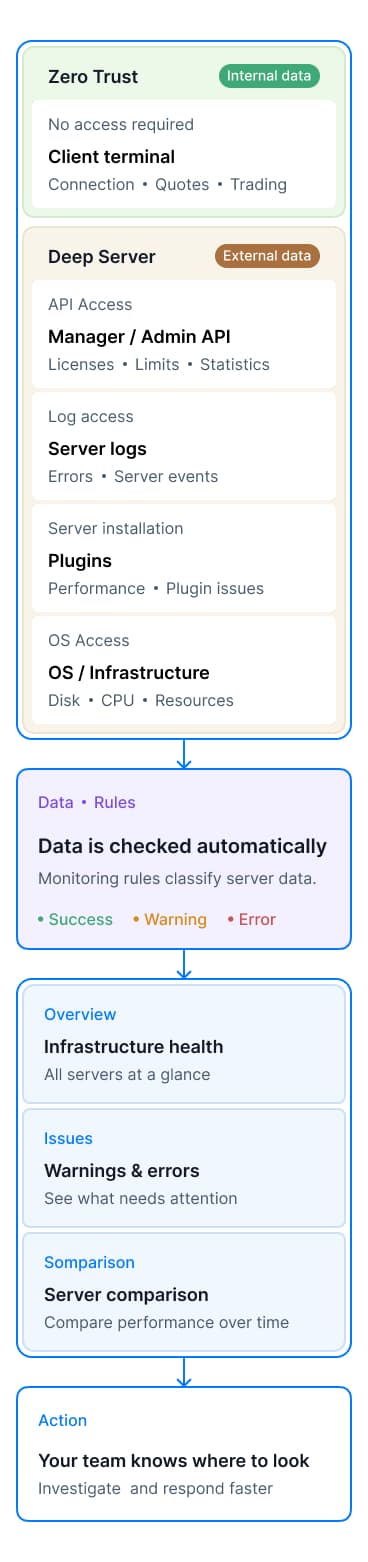
The rules are configured for the broker’s environment, and the system continuously applies them to monitoring data to classify conditions as Success, Warning, or Error.
Monitoring cannot prevent every incident, but it can help teams detect warning signs and problems earlier.
Configurable monitoring rules flag unusual conditions so dealing and technical teams can investigate before an issue becomes more serious.
Instead of checking every server manually, dealers can focus on servers and metrics that require attention.
The system continuously evaluates monitoring data and classifies it as Success, Warning, or Error.
Yes. You can create rules using individual metrics or combinations of metrics.
Set separate Warning and Error conditions, define your own thresholds, and choose how many consecutive checks must trigger an alert status.
This helps reduce unnecessary warnings and focus on issues that matter to your brokerage.
The level of access depends on the monitoring required.
Some checks can run without server access, while deeper monitoring can use Manager/Admin API access, server logs, plugins, and operating system data.
Yes. Zero Trust Monitoring is included with Deep Server Monitoring at no additional cost.
It checks the trading environment from the outside, while Deep Server Monitoring provides internal visibility into servers and infrastructure.
Together, they cover both external and internal monitoring.