

How Devreon handles broker migration
Technical expertise behind every migration

Zero-surprise MT4 to MT5 migration

The data transfer itself can take as little as 30 minutes for a straightforward environment or several hours for more complex broker setups.
The overall migration project is usually much longer. It includes assessment, planning, testing, pilot migrations, and operational preparation.
Depending on the broker’s infrastructure and rollout strategy, the planning and preparation phase can take from a few days to several weeks or even a few months.
The timeline also depends on the broker’s internal processes and how the migration is organized.
For example, some brokers complete the migration in a single cutover, while others migrate accounts in planned iterations over several weeks.
At Devreon, we start every project with an assessment of your MT4/MT5 environment. Based on the results, we provide a realistic timeline.
Downtime depends on the broker’s infrastructure, but Devreon plans the migration to keep trading downtime as low as possible.
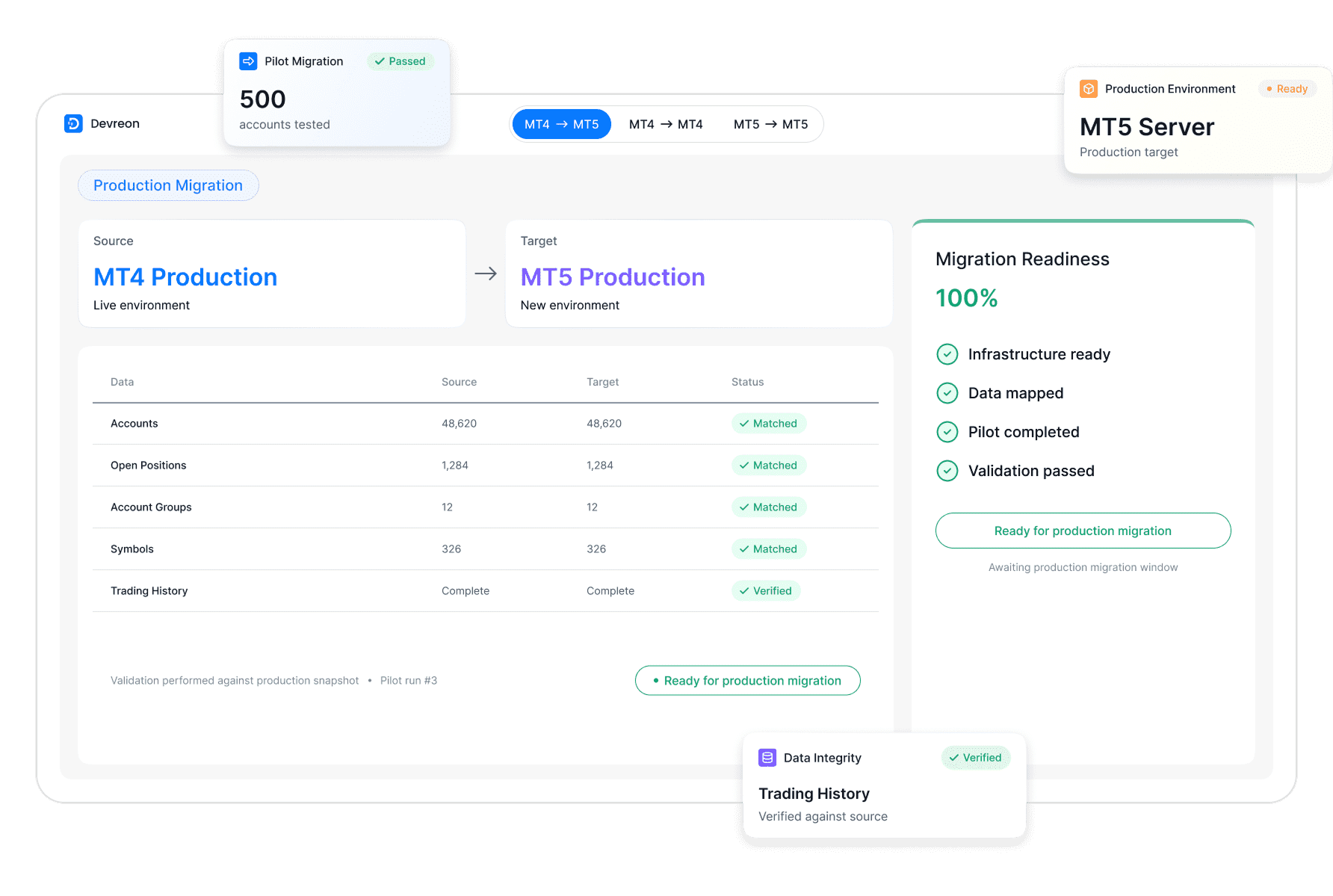
Before the final switch, we assess the environment, prepare the migration strategy, run pre-migration checks, and validate the migrated data.
For larger or more complex projects, we can also run a pilot migration to reduce risk before moving all accounts and trading data.
It depends on the migration scenario. Some migration types allow password preservation, while others require new passwords because of platform limitations.
We help brokers prepare the transition and minimize the operational impact on clients and support teams.
Yes. We migrate business-critical trading data, including accounts, balances, trading history, and open positions.
Open positions are one of the most complex parts of any migration. Every broker’s infrastructure is different, so we adapt the migration to your platform, validate the results, and verify everything before going live.
Yes. We support migrations into existing production environments, not just empty servers.
Many brokers already have live accounts, groups, symbols, and integrations in place. We adapt the migration to your existing infrastructure while minimizing disruption to current operations.
Yes. We run a pilot migration to validate the process before production.
It helps uncover technical and operational issues early, reducing risk during the final migration.
It depends on the migration. We choose the most suitable approach for your environment.
Where supported, database-level migration can provide a faster and more efficient transfer for large-scale projects.
That’s exactly where our migration expertise matters.
Every broker’s infrastructure is different. We adapt the migration to your environment instead of forcing your business into a standard process.
Every migration is validated before go-live and verified again after production.
We check accounts, balances, trading history, open positions, and platform configuration to catch issues before they impact your brokerage.
Every migration carries technical and operational risks. Without proper planning, even small issues can lead to client complaints, reporting errors, trading disruptions, or costly manual fixes.
We reduce those risks through assessment, simulations, controlled migration, validation, and post-migration support.
Yes. Migration doesn’t end when the data is moved.
After go-live, we continue validating the results, help resolve unexpected issues, and support your team until the new environment is running as expected.